

An engine converts fuel into motion by burning an air and fuel mixture inside sealed cylinders, using the resulting pressure to push pistons that spin a crankshaft. This guide explains engine fundamentals from the ground up—what an engine is, how its parts fit together, the strokes that repeat thousands of times per minute, and how separate systems cooperate to produce usable power. Whether you’re a curious beginner, an automotive student, or an apprentice building your foundation, you’ll walk away understanding the engine as one connected machine rather than a pile of loose components.
What Are Engine Fundamentals and Why Do They Matter?
Engine fundamentals are the core principles that explain how an engine produces motion from fuel. They cover the basic physics of combustion, the main components, the repeating cycle of strokes, and the systems that keep everything running.
Understanding these fundamentals matters because nearly every automotive skill builds on them. Diagnosing a misfire, choosing between a turbocharged and naturally aspirated car, or grasping why diesels pull hard at low speeds all start with the same foundation. Once you understand how one cylinder works, you understand the whole engine—the rest is simply repetition and refinement.
What Is an Engine?
An engine is a machine that converts energy into mechanical work. In cars, that energy comes from burning fuel, and the mechanical work is the rotation of a crankshaft that ultimately turns the wheels.
Most vehicles use an internal combustion engine (ICE), where fuel burns inside the engine’s cylinders. This differs from an external combustion engine, such as a steam engine, where fuel burns outside the working chamber to heat a separate fluid. Internal combustion is more compact and efficient for cars, which is why it has dominated the road for over a century.
It also helps to separate the engine from the powertrain. The engine produces power. The powertrain is the full chain that delivers that power to the road—the engine plus the transmission, driveshaft, differential, and axles. The engine is the source; the powertrain is the delivery route.
How Are Engines Classified?
Engines are grouped by how they burn fuel, how their parts move, how many strokes complete a cycle, how they ignite the mixture, and how they’re arranged. These categories overlap—a single engine can belong to several at once.
| Classification | Type A | Type B | Key difference |
| Combustion location | Internal combustion | External combustion | Where the fuel burns (inside vs. outside the chamber) |
| Motion type | Reciprocating | Rotary (Wankel) | Pistons moving up and down vs. a spinning rotor |
| Strokes per cycle | Four-stroke | Two-stroke | Number of piston movements per power event |
| Ignition method | Spark ignition | Compression ignition | A spark plug lights the mix vs. heat from compression |
| Fuel | Gasoline | Diesel | Fuel type and how it ignites |
| Air delivery | Naturally aspirated | Forced induction | Ambient air pressure vs. a turbo or supercharger |
| Cooling | Air-cooled | Liquid-cooled | Airflow over fins vs. coolant circulating through the block |
The final way to classify engines is by configuration—how the cylinders are physically arranged. Common layouts include inline (cylinders in a row), V (two banks set at an angle), and flat or “boxer” (cylinders lying horizontally opposed). Configuration affects an engine’s size, balance, and where it fits in the vehicle.
Core Engine Terminology You Should Know
Learning a handful of terms makes everything else easier to follow. These words describe the geometry, motion, and output of an engine.
- Bore: The diameter of a cylinder.
- Stroke: The distance a piston travels from top to bottom.
- Top Dead Center (TDC): The highest point a piston reaches.
- Bottom Dead Center (BDC): The lowest point a piston reaches.
- Swept volume: The space a piston displaces as it moves from BDC to TDC.
- Clearance volume: The space left above the piston at TDC.
- Displacement: The total swept volume of all cylinders combined, usually measured in liters or cubic centimeters.
- Compression ratio: How much the air-fuel mixture is squeezed, comparing the volume at BDC to the volume at TDC.
- Combustion chamber: The sealed space where the mixture burns.
- Cylinder: The bore in which a piston travels.
- Piston speed: How fast the piston moves, which rises with RPM.
- Firing order: The sequence in which cylinders fire.
- RPM: Revolutions per minute—how many full turns the crankshaft makes each minute.
- Torque: The twisting force the engine produces.
- Power (horsepower): How quickly the engine does work; a combination of torque and RPM.
- Volumetric efficiency: How well the engine fills its cylinders with air.
- Thermal efficiency: How much of the fuel’s energy becomes useful work rather than heat loss.
- Mean effective pressure: An average measure of the pressure pushing on the piston during combustion.
What Are the Major Engine Components ?
An engine is built from a stack of parts that either seal, move, or control the flow of gases. Each has a specific job, and each depends on the others.
| Component | Function |
| Engine block | The main structure that houses the cylinders |
| Cylinder | The chamber where the piston moves and combustion happens |
| Cylinder head | Seals the top of the cylinders and holds valves and spark plugs |
| Piston | Slides in the cylinder and transfers combustion pressure |
| Piston rings | Seal the gap between piston and cylinder wall |
| Connecting rod | Links the piston to the crankshaft |
| Crankshaft | Converts the piston’s up-and-down motion into rotation |
| Crankcase | Encloses the crankshaft at the bottom of the engine |
| Crankshaft bearings | Support the spinning crankshaft and reduce friction |
| Camshaft | Opens and closes the valves at the right moment |
| Valves | Let air-fuel in and exhaust gases out |
| Valve springs | Snap the valves closed after opening |
| Timing mechanism | Keeps the camshaft and crankshaft synchronized |
| Intake manifold | Distributes incoming air to the cylinders |
| Exhaust manifold | Collects spent gases and channels them out |
| Flywheel/flexplate | Smooths rotation and stores momentum |
| Gaskets and seals | Prevent leaks between mating surfaces |
The relationship between the piston, connecting rod, and crankshaft is the heart of the engine. The piston moves in a straight line; the crankshaft spins in a circle. The connecting rod bridges those two motions, much like your leg pumping a bicycle pedal—your knee moves up and down while the crank arm rotates.
How Does the Four-Stroke Engine Cycle Work?
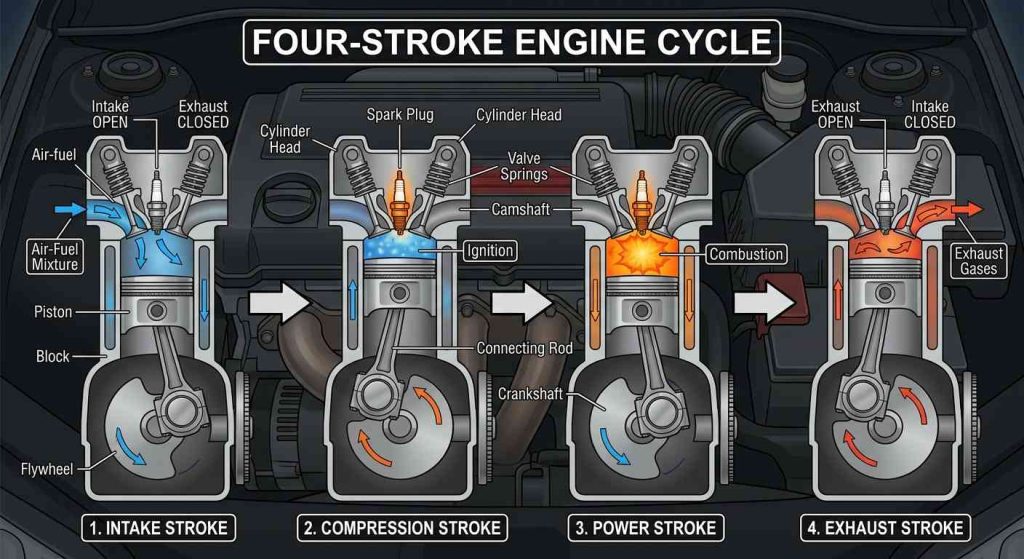
The four-stroke cycle is the sequence most car engines use to produce power. It takes four movements of the piston—two down, two up—and two full turns of the crankshaft to complete one cycle.
| Stroke | Piston movement | Valves | What happens |
| Intake | Moves down | Intake open, exhaust closed | Air and fuel are drawn into the cylinder |
| Compression | Moves up | Both closed | The mixture is squeezed, raising pressure and temperature |
| Power | Moves down | Both closed | The mixture ignites and expands, forcing the piston down |
| Exhaust | Moves up | Exhaust open, intake closed | Burned gases are pushed out of the cylinder |
Here’s the logic behind each step. During intake, the piston drops and creates low pressure, so air and fuel rush in—like pulling back a syringe plunger. On compression, both valves seal and the rising piston packs the mixture into a small space, which makes it far more explosive. At the top of compression, the power stroke begins: the mixture ignites, pressure spikes, and the expanding gases slam the piston back down. This is the only stroke that produces power; the other three set it up or clean up after it. Finally, the exhaust stroke pushes the burned gases out so fresh mixture can enter.
Only one cylinder fires at a time in a set order, so a four-cylinder engine always has one cylinder delivering power while the others are breathing, squeezing, or clearing out. That overlap is what keeps rotation smooth.
How Does a Two-Stroke Engine Compare to a Four-Stroke?
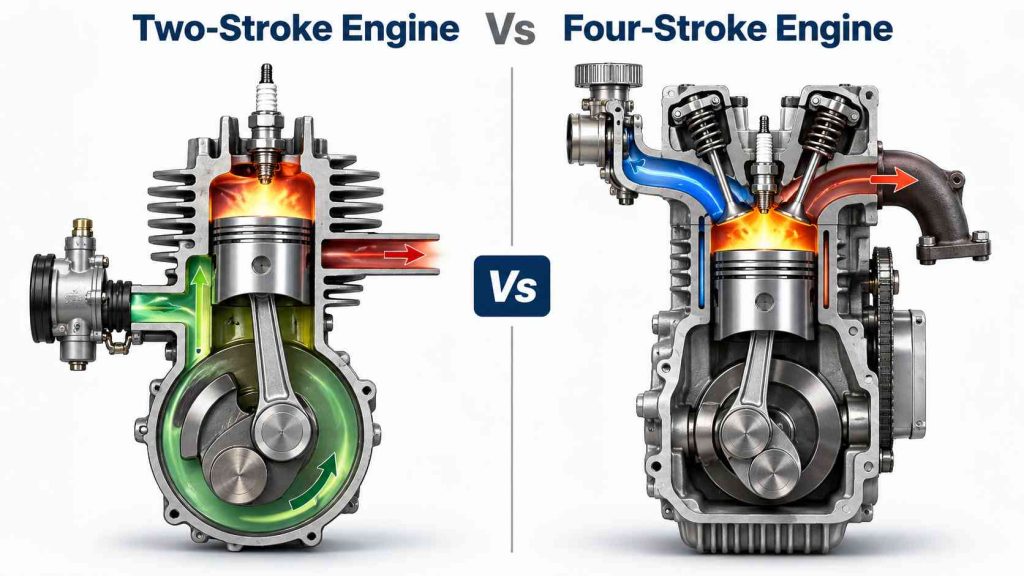
A two-stroke engine completes a full cycle in just two piston movements and one crankshaft revolution, so it fires twice as often as a four-stroke at the same speed. It combines the strokes—intake and compression happen together, as do power and exhaust.
| Feature | Two-stroke | Four-stroke |
| Piston movements per cycle | 2 | 4 |
| Power strokes per revolution | 1 | 1 every 2 revolutions |
| Power-to-weight | Higher | Lower |
| Fuel efficiency | Lower | Higher |
| Emissions | Higher | Lower |
| Typical uses | Small equipment, some motorcycles | Most cars and trucks |
Two-strokes are simple, light, and powerful for their size, which suits chainsaws, dirt bikes, and outboard motors. Four-strokes run cleaner and more efficiently, so they dominate passenger vehicles. The trade-off comes down to simplicity and power density versus efficiency and emissions.
How Does Combustion Create Mechanical Power?
Combustion creates mechanical power by turning a chemical reaction into pressure, pressure into force, and force into rotation. The chain is direct and worth following step by step.
Air and fuel mix inside the cylinder. The piston compresses that mixture, and an ignition source lights it. The burning mixture expands rapidly, creating high pressure that pushes down on the piston. That downward push travels through the connecting rod to the crankshaft, where it becomes a twisting force. As the crankshaft rotates, straight-line motion becomes circular motion.
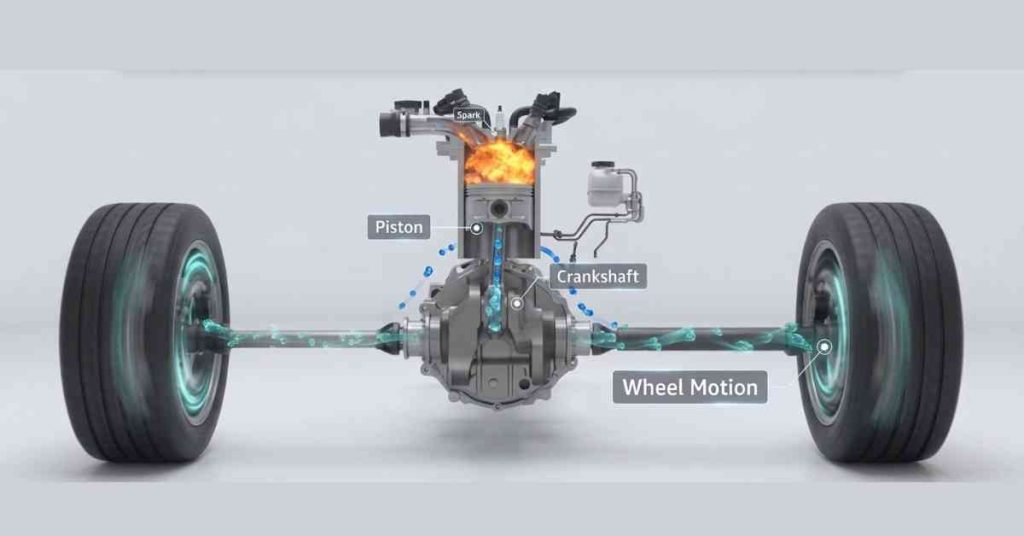
The distinction between the key terms matters:
- Combustion is the burning of the mixture.
- Pressure is what combustion creates inside the cylinder.
- Force is pressure acting on the piston’s surface.
- Torque is that force applied through the crankshaft’s leverage.
- Rotational motion is the spinning crankshaft.
- Power is how quickly all of this happens over time.
Think of it as a controlled explosion happening thousands of times a minute, each one nudging the crankshaft a little further around. Those nudges add up to the steady rotation that drives the wheels.
What Are the Major Engine Systems?
An engine relies on several supporting systems, each handling one essential task. On their own they do little; together they let the engine start, run, and stay alive.
| System | Job |
| Air intake/induction | Supplies clean air to the cylinders |
| Fuel system | Delivers and meters fuel (via carburetor or fuel injection) |
| Ignition system | Provides the spark to light the mixture |
| Exhaust system | Removes and treats burned gases |
| Valvetrain | Opens and closes valves in time with the cycle |
| Cranktrain | Converts piston motion into crankshaft rotation |
| Cooling system | Keeps operating temperature in a safe range |
| Lubrication system | Reduces friction and wear on moving parts |
| Engine management | Coordinates everything using sensors, an ECU, and actuators |
Older engines used a carburetor to blend air and fuel mechanically. Modern engines use fuel injection, which sprays a precise amount of fuel under electronic control for better efficiency and cleaner emissions. The engine management system—built around the electronic control unit (ECU)—reads sensors throughout the engine and adjusts fuel, spark, and airflow moment to moment.
Each of these systems is a deep topic in its own right. For detailed breakdowns, see supporting guides on the fuel system, ignition system, cooling system, lubrication system, and engine management.
How Do the Systems Work Together?
The systems work together as a single loop of air in, fuel added, spark applied, power out, and gases expelled—all timed and managed electronically. No system operates alone.
Consider a single running moment. The intake system feeds air in. The fuel system adds the right amount of fuel. The valvetrain opens and closes the valves in time. The ignition system fires the spark. Combustion drives the cranktrain. The exhaust system clears the leftovers. Throughout, the cooling and lubrication systems keep temperatures and friction under control, and the engine management system supervises the whole sequence, adjusting thousands of times a minute. Remove any one system and the engine either stops or destroys itself. That interdependence is the core idea behind treating the engine as one machine.
How Does an Engine Behave Under Different Conditions?
An engine constantly adjusts how much air and fuel it uses based on what the driver asks of it. The same engine behaves very differently at a cold start than it does at highway speed.
- Starting: The starter motor spins the crankshaft until combustion takes over.
- Cold operation: The engine runs a richer mixture and warms up toward its ideal temperature.
- Idle: The engine turns just fast enough to keep itself running with no load.
- Light load: Gentle cruising or slow acceleration uses modest fuel and air.
- Acceleration: More air and fuel enter, producing more power on demand.
- Cruising: The engine settles into an efficient, steady state.
- Heavy load: Climbing or towing demands maximum air, fuel, and torque.
- High RPM: The engine breathes and fires rapidly to sustain high power.
- Deceleration: Fuel delivery drops, and often cuts off, as the engine coasts.
The engine management system handles these transitions seamlessly, which is why a modern car feels smooth whether you’re crawling in traffic or merging onto a freeway.
What Are the Fundamentals of Engine Performance?
Engine performance comes down to how much air and fuel an engine can process and how efficiently it turns that into useful rotation. A few key measures describe it.
Torque is twisting force—it’s what you feel pushing you back in your seat. Power (measured in horsepower) is how fast the engine does work, and it depends on both torque and RPM. A simple way to hold the difference:
| Measure | What it describes | Everyday feel |
| Torque | Twisting force | Pulling strength, especially low down |
| Power | Rate of doing work | Top-end speed and sustained pace |
Other measures round out the picture. Displacement and compression ratio set how much mixture the engine handles and how hard it squeezes it. Volumetric efficiency describes how completely the cylinders fill with air. Thermal efficiency describes how much fuel energy becomes work instead of waste heat. Specific fuel consumption and engine load describe how much fuel the engine burns for the work it’s doing. Better breathing and better burning are the two levers behind nearly every performance gain.
Naturally Aspirated vs. Turbocharged vs. Supercharged
These three terms describe how an engine gets its air. More air allows more fuel to burn, which produces more power.
| Type | How it gets air | Trade-offs |
| Naturally aspirated | Draws air at normal atmospheric pressure | Simple and responsive, but power is limited by engine size |
| Turbocharged | Uses exhaust gases to spin a compressor that forces in extra air | Strong power gains and efficiency, with possible lag |
| Supercharged | Uses a belt driven by the engine to force in extra air | Instant response, but draws some engine power to run |
A naturally aspirated engine relies only on the vacuum its pistons create. Forced induction—turbocharging or supercharging—packs in extra air so a smaller engine can perform like a larger one. Turbochargers recycle otherwise wasted exhaust energy, while superchargers deliver immediate boost at the cost of a little engine power. Choose naturally aspirated for simplicity and predictable response; choose forced induction when you want more power from a compact engine.
Gasoline vs Diesel : How Do They Differ?
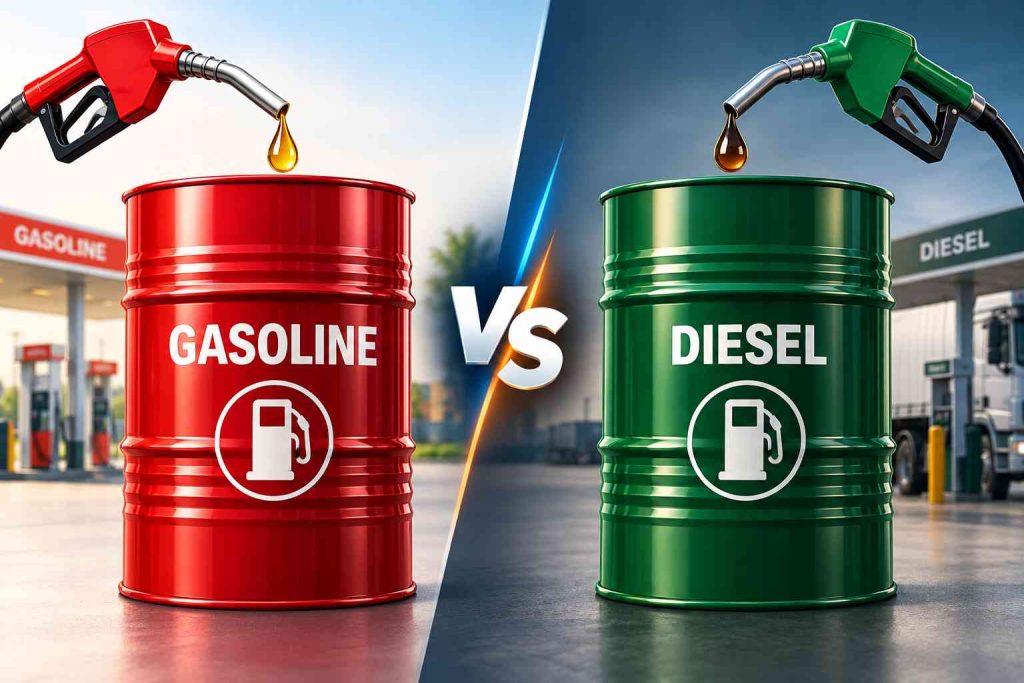
Gasoline and diesel engines share the same basic four-stroke cycle but differ in how they ignite fuel. Gasoline engines use a spark plug; diesel engines use heat from extreme compression.
| Feature | Gasoline | Diesel |
| Ignition | Spark plug | Compression heat |
| Compression ratio | Lower | Higher |
| Torque character | Builds with RPM | Strong at low RPM |
| Fuel efficiency | Lower | Higher |
| Typical strengths | Smooth, high-revving | Pulling power, economy |
Because diesel engines compress air so tightly, the air gets hot enough to ignite fuel on its own the instant it’s injected—no spark needed. That high compression is also why diesels produce strong low-end torque and better fuel economy, making them favorites for trucks and towing. Gasoline engines rev more freely and run more smoothly, which suits everyday passenger cars. Pick gasoline for refinement and cost; pick diesel when low-speed pulling power and long-distance efficiency matter most.
Frequently Asked Questions
How does a car engine work in simple terms?
A car engine mixes air and fuel, compresses it inside a cylinder, and ignites it. The burning mixture expands and pushes a piston, which spins the crankshaft. That rotation eventually turns the wheels. This happens hundreds of times a second across all cylinders.
What is the difference between torque and horsepower?
Torque is the twisting force an engine produces, felt most as pulling strength. Horsepower measures how quickly the engine does work and depends on both torque and RPM. Torque gets you moving; horsepower keeps you accelerating at higher speeds.
Why do most cars use four-stroke engines instead of two-stroke?
Four-stroke engines are more fuel efficient and produce fewer emissions than two-strokes. They separate each phase of the cycle into its own stroke, which allows cleaner combustion. Two-strokes are lighter and more powerful for their size, so they suit small equipment rather than passenger cars.
What is compression ratio and why does it matter?
Compression ratio compares the cylinder’s volume when the piston is at the bottom to its volume at the top. A higher ratio squeezes the mixture more, which generally improves efficiency and power. It’s a major reason diesel engines are more efficient than gasoline engines.
What’s the difference between an engine and a motor?
In everyday speech the words are used interchangeably. Technically, an engine converts fuel into motion through combustion, while a motor often refers to a device that runs on electricity. Both produce mechanical rotation, but from different energy sources.
Do I need to understand engine fundamentals to maintain my car?
Basic engine fundamentals make maintenance easier and cheaper. Knowing how the systems connect helps you spot problems early, understand a mechanic’s advice, and make smarter decisions about repairs and upgrades. You don’t need to be an expert to benefit.